

Why Some Slot Features Are Unavailable in Certain Countries: Local Versions of the Same Game
A slot with the same name, artwork and basic mechanics can behave differently depending on the country in which it is offered. A player may find autoplay in one market but not another, notice a slower spin cycle, see a different maximum stake or discover that a progressive jackpot is absent entirely. These differences are usually deliberate rather than technical faults. By 2026, regulated gambling markets apply increasingly detailed rules to game design, speed, staking and player interaction. Software suppliers and casino operators therefore have to adapt games before making them available locally. In some cases, a relatively small setting is changed; in others, a separate approved version is required. Understanding these regional differences is useful because a familiar title should not automatically be assumed to have identical features, limits or gameplay conditions in every country.
Why the Same Slot Can Have Different Features Between Countries
Online slot regulation is largely national or jurisdiction-specific rather than universal. A game developed for international distribution may therefore encounter several different sets of requirements before reaching players. Regulators can determine how quickly games operate, whether consecutive spins can start automatically, which information must remain visible, how stakes are presented and which types of prize mechanics are acceptable. A feature that is permitted under one licence can consequently be restricted under another. This does not necessarily require the supplier to create a completely new slot. The theme, symbols, animations and principal game concept may remain recognisable while selected functions are disabled or adjusted to satisfy local rules. The result is effectively a regional edition of the same title.
Certification and approval procedures are another reason for these differences. Suppliers cannot simply assume that a version accepted in one regulated market will automatically qualify elsewhere. Germany provides a particularly clear example. Under the Glücksspielstaatsvertrag 2021, a virtual slot must be approved before an authorised operator can offer it, and a version of the game has to be supplied to the competent authority for examination. Material changes made after approval can also require further authorisation. This approach encourages suppliers to maintain precisely controlled local builds because changing an important mechanic after certification is not simply an ordinary software update. The approved version has to continue meeting the conditions under which it was accepted.
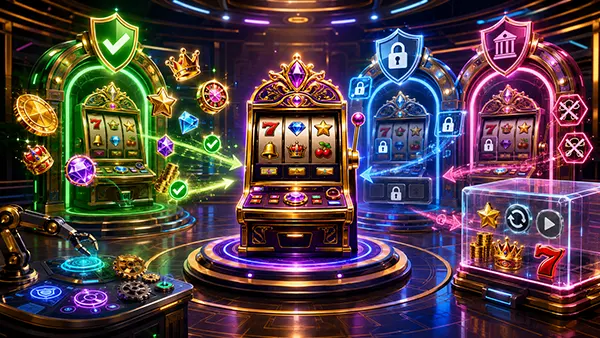
Local adaptations also allow suppliers to distribute the same underlying game concept without removing it from a market entirely. If a regulator prohibits autoplay, for example, the practical response is normally to disable that control rather than abandon an otherwise compliant title. A similar principle applies to stake ranges, spin timing and certain jackpot mechanics. For players, this can create the impression that a feature has mysteriously disappeared. In reality, the operator may be serving a version configured specifically for the player’s jurisdiction. Location, licence conditions and local technical requirements can therefore influence the version displayed even when the game’s name and visual design are identical to those used elsewhere.
What Can Change While the Game Still Looks Familiar
The most visible differences usually concern controls rather than graphics. Autoplay buttons, turbo modes, quick-spin settings and other shortcuts can appear or disappear according to local requirements. Stake selectors can also have different upper limits. A slot originally designed with a broad betting range may have that range reduced for a particular country without changing its reels or theme. Game timing is another important variable. If local rules require a longer minimum cycle, the compliant edition has to prevent the next paid spin from starting too quickly. These alterations can make two versions of the same title feel noticeably different even though their screens initially appear almost identical.
Prize features can require more substantial adaptation. Progressive jackpots are a good example because they depend on value being accumulated towards future prizes. Germany prohibits this structure for regulated virtual slots: winnings must be based on a multiple of the stake determined before play, while stakes or winnings cannot be accumulated to create future jackpot prizes. A game designed around a progressive prize therefore cannot simply be distributed unchanged under the German virtual-slot rules. Depending on its design, a compliant alternative may require a fixed prize structure or the title may be unavailable. Similar considerations can affect any mechanic that conflicts directly with local requirements.
Players should also distinguish between visual similarity and mathematical identity. The same branding does not by itself prove that every local release has exactly the same rules, stake range or return information. Suppliers may maintain separately certified configurations, while operators must display the conditions applying to the version actually offered. The relevant information is therefore the paytable and help section inside the local game, not a screenshot, video or review prepared for another country. When comparing versions, it is worth checking the stated RTP, permitted stake range, bonus rules and available controls directly. A missing function is not evidence that a slot is defective, just as a familiar name is not evidence that every regional configuration is identical.
Great Britain and Germany Show How Regulation Changes Slot Design
Great Britain provides one of the clearest examples of regulatory rules altering familiar slot functions. Gambling Commission requirements applying in 2026 state that an online slot cycle must allow at least 2.5 seconds before the next cycle can begin, and the player must take an individual action to start each new cycle. Autoplay is not permitted for online gaming. Controls intended to shorten the time before a result appears, including turbo, quick-spin and slam-stop functions, are also prohibited for remote casino games. The rules additionally prevent casino games from using win-style visual or audio celebrations when the return is equal to or lower than the amount staked. As a result, a British edition can differ noticeably from a version of the same game supplied in a jurisdiction with less restrictive design rules.
Stake limits add another important local difference. Since 2025, online slots offered under Great British remote casino licences have been subject to maximum stakes per game cycle. Players aged 25 or over can stake no more than £5 per cycle, while those aged 18 to 24 are limited to £2. These limits remain relevant in 2026 and have to be considered when games are configured for the British market. A title designed internationally with much higher selectable stakes cannot retain those options for affected customers. The restriction can also influence mechanics involving additional paid decisions within a single game cycle, because the total amount staked during that cycle must remain within the applicable maximum.
These requirements are actively enforced rather than existing only as written standards. In June 2026, the Gambling Commission announced a £122,835 regulatory settlement involving supplier Stakelogic BV after games supplied to the Great British market were found to operate faster than the required minimum. Tiger Temple 88 had been recorded at 1.97 seconds between spins, and testing identified another 15 affected games. The supplier suspended the relevant games while the issue was corrected. The case is particularly useful when considering local versions because it demonstrates that even a relatively small timing difference can make software non-compliant. A game may therefore need specific settings and testing for Great Britain even if another version operates normally elsewhere.
German Rules Create an Even More Distinctive Local Experience
Germany applies a different combination of restrictions to regulated virtual slots. Under the current rules, each game must be started manually, meaning software cannot automatically begin the next paid game after the previous one finishes. A game must last an average of at least five seconds, and the maximum stake is €1 per game. Stakes and winnings must also be expressed in euros and cents rather than being converted into points or alternative units. These conditions immediately affect several elements that are common in international slots. A rapid-spin version with autoplay and high-value stake buttons would require significant adjustment before it could meet the German requirements.
German regulation also prohibits simultaneous play of multiple virtual slots. Only one can be displayed to a player at a time. In addition, progressive jackpot structures are prohibited under the virtual-slot provisions because stakes or winnings cannot be accumulated to create prizes for future games. This combination produces a particularly recognisable local format: manual starts, slower cycles, a €1 maximum stake and no progressive jackpot accumulation. The artwork may still resemble an international edition closely, but the practical experience can be different. A player who has previously used the same title outside Germany may therefore notice several missing controls or mechanics immediately.
The Netherlands provides another useful example showing that regional restrictions are not limited to Britain and Germany. The Dutch Gambling Authority, Kansspelautoriteit, states that autoplay is prohibited. In March 2025 it took action after identifying gambling software that allowed automatic continuation of play and required the affected game to be checked again before returning to use. The authority also reminded licensed businesses that they are responsible for checking software supplied by third parties for prohibited functions. This illustrates an important point for 2026: an operator cannot rely solely on the fact that a game comes from an established supplier. The version actually offered locally still has to comply with the rules of that jurisdiction.
Local Rules Can Affect Stakes, RTP Information and Bonus Mechanics
Stake controls are among the easiest regional differences for players to identify because they are visible before a spin begins. A supplier may design a game to support a wide range of bets, yet an authorised local version cannot exceed limits imposed by the regulator. Britain now provides age-dependent maximum stakes for online slots, while Germany imposes a €1 maximum for regulated virtual slots. The result can be very different stake menus for the same basic title. This also explains why screenshots from international casino sites are sometimes misleading when used to judge a local edition: the buttons shown in another country may simply not be permitted under the rules applying to the player.
Return information deserves separate attention. RTP describes the theoretical proportion of stakes a game is designed to return over a very large number of plays; it does not predict the outcome of an individual session. Local rules can determine how information about game probabilities and returns must be presented. Germany, for example, requires the probability of winning the maximum prize and the average return per euro staked to be displayed to players. A player should therefore rely on the information attached to the locally available game rather than assuming that an RTP figure quoted for an edition offered elsewhere must apply. The same principle is useful whenever a supplier has more than one approved configuration of a title.
Bonus mechanics can also be affected indirectly by local stake and game-cycle rules. A feature involving another paid decision cannot be treated separately from the regulatory definition of a game merely because it appears behind a bonus button. In Great Britain, for example, the online slot stake limit applies to the amount risked during a game cycle, while the Gambling Commission’s guidance recognises that additional staking opportunities within a cycle still count towards the applicable maximum. In Germany, the €1 maximum stake and requirement for individual game starts create another set of constraints. Consequently, a paid mechanic that works in one jurisdiction may need a lower-cost implementation, a redesigned structure or removal in another.
What Players Should Check When a Familiar Feature Is Missing
The first useful check is the game’s own information section. It should identify the rules, available features, stake range and relevant return information for the version currently being played. This is more reliable than comparing the game with promotional videos, screenshots or reviews produced for a different country. An article published several years earlier can also describe a feature that has since been removed following regulatory changes. Great Britain’s stake limits introduced in 2025 are a good example of why dates matter: an older review may show stakes that are no longer available to British customers. Current local game information should therefore take priority when details conflict.
The second check is the operator’s regulatory status in the player’s country. A feature missing from an authorised local version may be absent precisely because the game has been adapted to comply with local consumer-protection rules. Finding the same feature on an offshore site does not establish that the licensed edition is incomplete. It may instead show that the other site is operating under different rules or is not authorised for that jurisdiction. Trying to bypass geographic restrictions to obtain another edition can also remove protections associated with the locally regulated service and may breach the operator’s terms. Local availability should therefore be treated as part of the regulatory framework rather than simply as a software preference.
Finally, players should remember that regulatory differences can change over time. Rules introduced in Britain in 2021 altered autoplay, speed and presentation, new online slot stake limits followed in 2025, and enforcement activity continued in 2026. Germany maintains a substantially different model with manual starts, five-second game timing, €1 stakes and a jackpot prohibition, while the Netherlands separately enforces its ban on autoplay. Suppliers serving several regulated markets consequently have a continuing reason to maintain local configurations of the same titles. For players, the practical rule is simple: judge a slot by the version legally offered where it is being played. Its name and artwork may travel across borders, but not every feature is allowed to travel with them.